
Type 2 diabetes nursing concept map
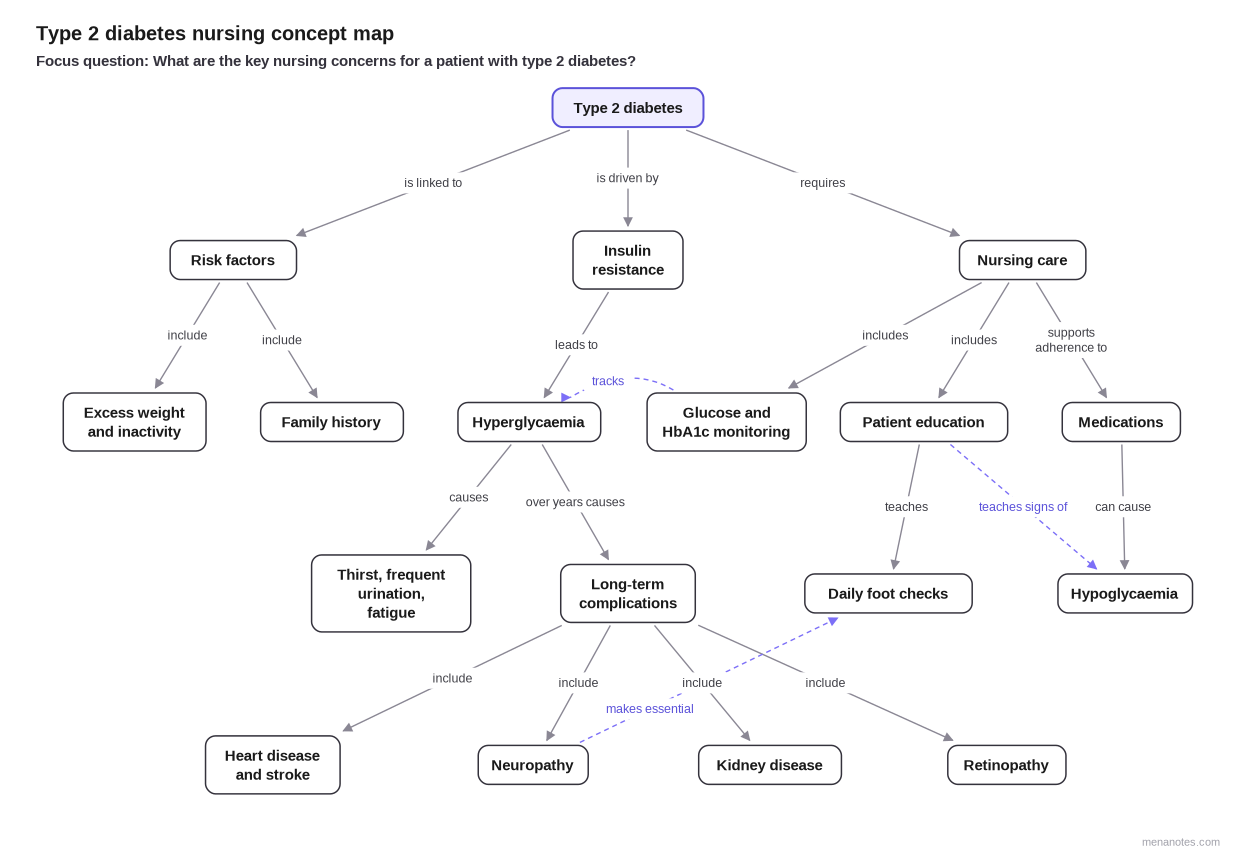
Nursing students use concept maps to connect a condition’s pathophysiology to assessment and care. This study map links type 2 diabetes from its causes to its complications and the nursing care that addresses each.
Read the map as sentences
Every arrow is a proposition. Read aloud, the map says:
- Type 2 diabetes is linked to Risk factors
- Type 2 diabetes is driven by Insulin resistance
- Type 2 diabetes requires Nursing care
- Risk factors include Excess weight and inactivity
- Risk factors include Family history
- Insulin resistance leads to Hyperglycaemia
- Hyperglycaemia causes Thirst, frequent urination, fatigue
- Hyperglycaemia over years causes Long-term complications
- Long-term complications include Heart disease and stroke
- Long-term complications include Neuropathy
- Long-term complications include Kidney disease
- Long-term complications include Retinopathy
- Nursing care includes Glucose and HbA1c monitoring
- Nursing care includes Patient education
- Nursing care supports adherence to Medications
- Glucose and HbA1c monitoring tracks Hyperglycaemia
- Patient education teaches Daily foot checks
- Medications can cause Hypoglycaemia
- Patient education teaches signs of Hypoglycaemia
- Neuropathy makes essential Daily foot checks
Type 2 diabetes nursing: what the map shows
In type 2 diabetes the body’s cells respond poorly to insulin, and over time the pancreas cannot make enough to compensate, so blood glucose stays high. Excess weight, physical inactivity, age and family history raise the risk.
Persistent hyperglycaemia causes thirst, frequent urination, fatigue and blurred vision, and over years it damages blood vessels and nerves. That leads to heart disease and stroke, neuropathy, kidney disease and retinopathy. HbA1c reflects average blood glucose over roughly the past two to three months.
Nursing care centres on monitoring, medication support and education: healthy eating and activity, recognising and treating hypoglycaemia, and daily foot inspection, because neuropathy can hide injuries that become ulcers.
Common mistakes
- Type 2 diabetes is not always treated with insulin; many patients start with lifestyle changes and oral medication.
- Hypoglycaemia is a treatment side effect to teach about, mainly with insulin and sulfonylureas; it is not a symptom of untreated type 2 diabetes.
A study aid for learning how the concepts connect, not clinical guidance. Follow your programme’s care-plan format and your facility’s protocols in practice.
Make it your own
Drawing the map yourself is where the learning happens. Start from the focus question, list the concepts first, then link them with your own words. A blank concept map template gives you the boxes; the concept map guide covers the method.
Make and edit this map in Mena on iPad
Mena is a canvas app for iPad, iPhone and Mac, free to start. Paste this map in, rearrange it, add your own notes and sketches, and turn concepts into flashcards.
Get Mena on the App Store- Copy this map as text.
- In a Mena board, open More tools in the toolbar, choose Diagram from Text and paste. Each concept becomes a shape and each linking phrase a connector label.
- Drag concepts around, rename linking phrases and draw your own cross-links. Connectors stay attached when you move a shape.
- Export the finished board as PNG, SVG or PDF.
More concept map examples
-
 Nursing
Heart failure nursing concept map
How does heart failure affect the body, and what does nursing care focus on?
-
 Biology
Photosynthesis concept map
How do plants turn light energy into stored chemical energy?
-
 Biology
Cellular respiration concept map
How do cells release usable energy from glucose?