
Cellular respiration concept map
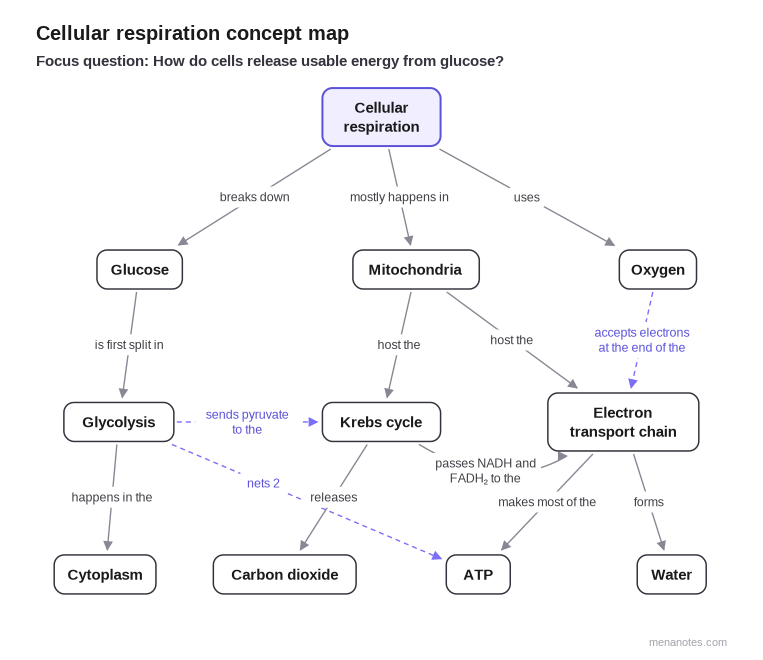
Cellular respiration releases the energy stored in glucose and packs it into ATP, the molecule cells spend to do work. This map shows the three stages, where each happens, and what goes in and comes out.
Read the map as sentences
Every arrow is a proposition. Read aloud, the map says:
- Cellular respiration breaks down Glucose
- Cellular respiration mostly happens in Mitochondria
- Cellular respiration uses Oxygen
- Glucose is first split in Glycolysis
- Glycolysis happens in the Cytoplasm
- Glycolysis sends pyruvate to the Krebs cycle
- Mitochondria host the Krebs cycle
- Mitochondria host the Electron transport chain
- Krebs cycle releases Carbon dioxide
- Krebs cycle passes NADH and FADH₂ to the Electron transport chain
- Oxygen accepts electrons at the end of the Electron transport chain
- Electron transport chain makes most of the ATP
- Electron transport chain forms Water
- Glycolysis nets 2 ATP
Cellular respiration: what the map shows
The overall equation is C₆H₁₂O₆ + 6O₂ → 6CO₂ + 6H₂O + energy, most of it captured as ATP. It is roughly photosynthesis run in reverse.
Glycolysis splits glucose into two pyruvate molecules in the cytoplasm, with a net gain of 2 ATP. With oxygen present, pyruvate enters the mitochondrion, is converted to acetyl-CoA and feeds the Krebs (citric acid) cycle, which releases carbon dioxide and loads electron carriers NADH and FADH₂.
The electron transport chain on the inner mitochondrial membrane uses those carriers to pump protons; ATP synthase then makes most of the cell’s ATP. Oxygen is the final electron acceptor and becomes water. Modern estimates put the total at about 30 to 32 ATP per glucose; older textbooks give 36 to 38.
Common mistakes
- Respiration is not breathing. Breathing moves air; cellular respiration is a chemical process inside every living cell.
- Without oxygen, cells fall back on fermentation, which makes only the 2 ATP from glycolysis.
Make it your own
Drawing the map yourself is where the learning happens. Start from the focus question, list the concepts first, then link them with your own words. A blank concept map template gives you the boxes; the concept map guide covers the method.
Make and edit this map in Mena on iPad
Mena is a canvas app for iPad, iPhone and Mac, free to start. Paste this map in, rearrange it, add your own notes and sketches, and turn concepts into flashcards.
Get Mena on the App Store- Copy this map as text.
- In a Mena board, open More tools in the toolbar, choose Diagram from Text and paste. Each concept becomes a shape and each linking phrase a connector label.
- Drag concepts around, rename linking phrases and draw your own cross-links. Connectors stay attached when you move a shape.
- Export the finished board as PNG, SVG or PDF.
More concept map examples
-
 Biology
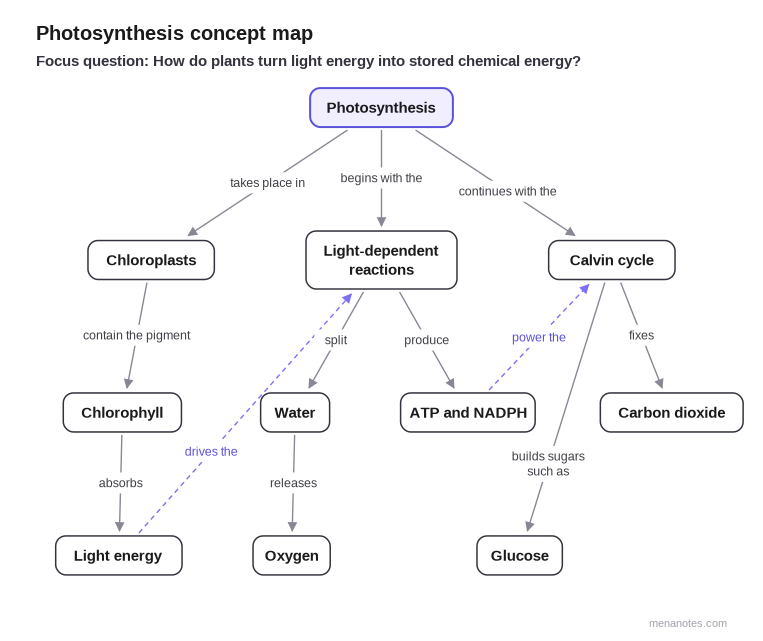
Photosynthesis concept map
How do plants turn light energy into stored chemical energy?
-
 Biology
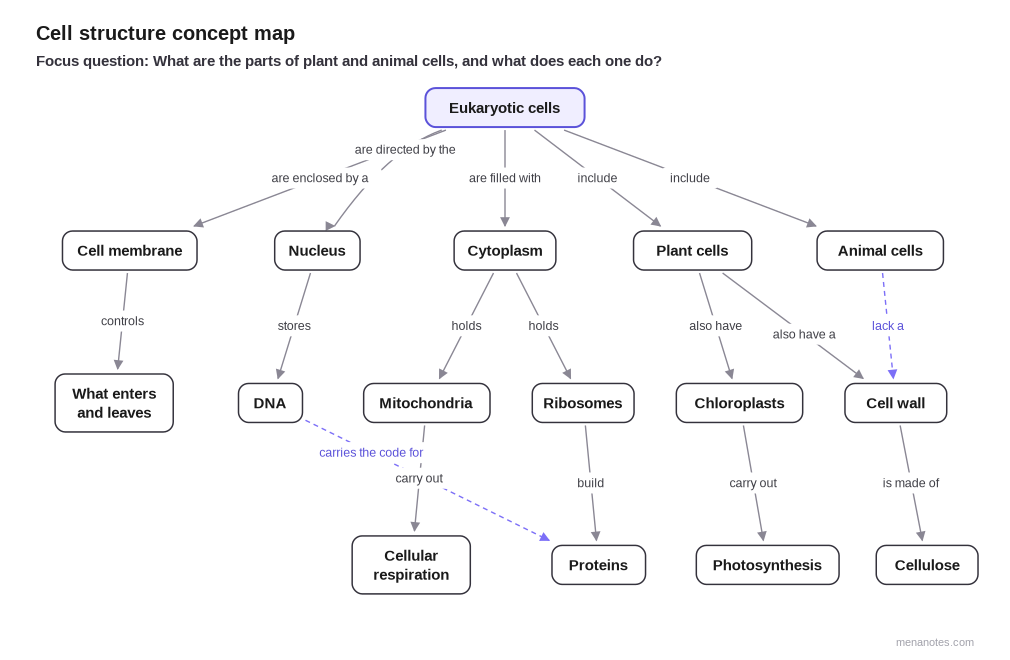
Cell structure concept map
What are the parts of plant and animal cells, and what does each one do?
-
 Biology
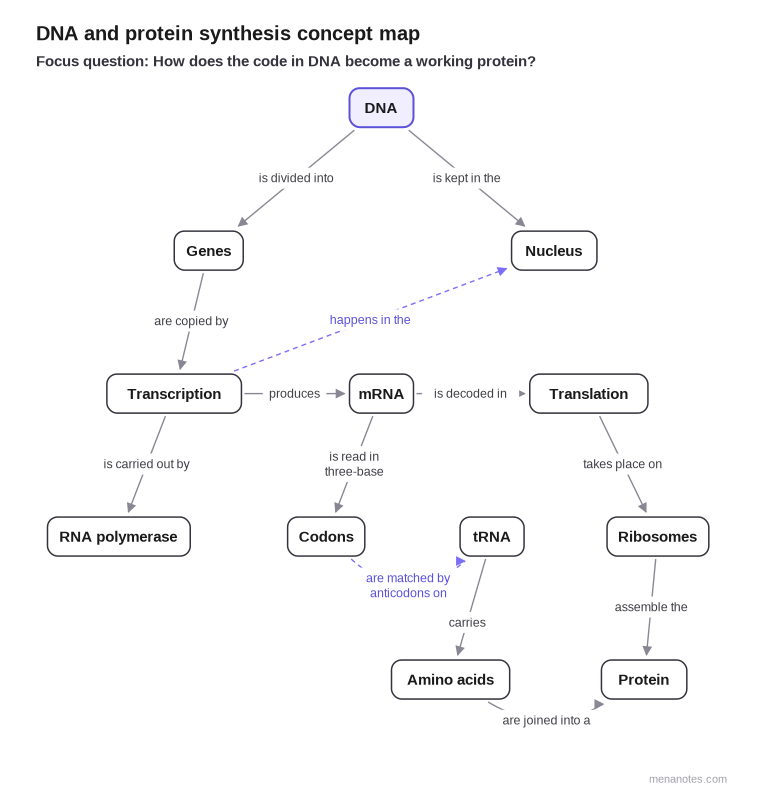
DNA and protein synthesis concept map
How does the code in DNA become a working protein?