Cell structure concept map
Plant and animal cells are both eukaryotic: their DNA sits inside a nucleus and their work is split between organelles. This map shows the parts they share and the extra structures only plant cells have.
Read the map as sentences
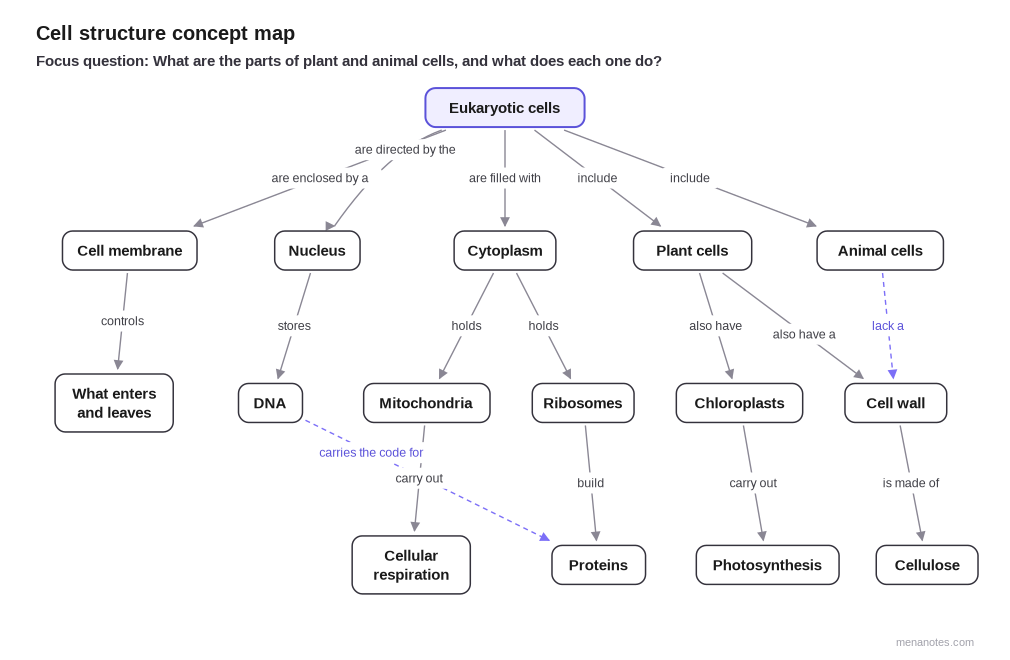
Every arrow is a proposition. Read aloud, the map says:
- Eukaryotic cells are enclosed by a Cell membrane
- Cell membrane controls What enters and leaves
- Eukaryotic cells are directed by the Nucleus
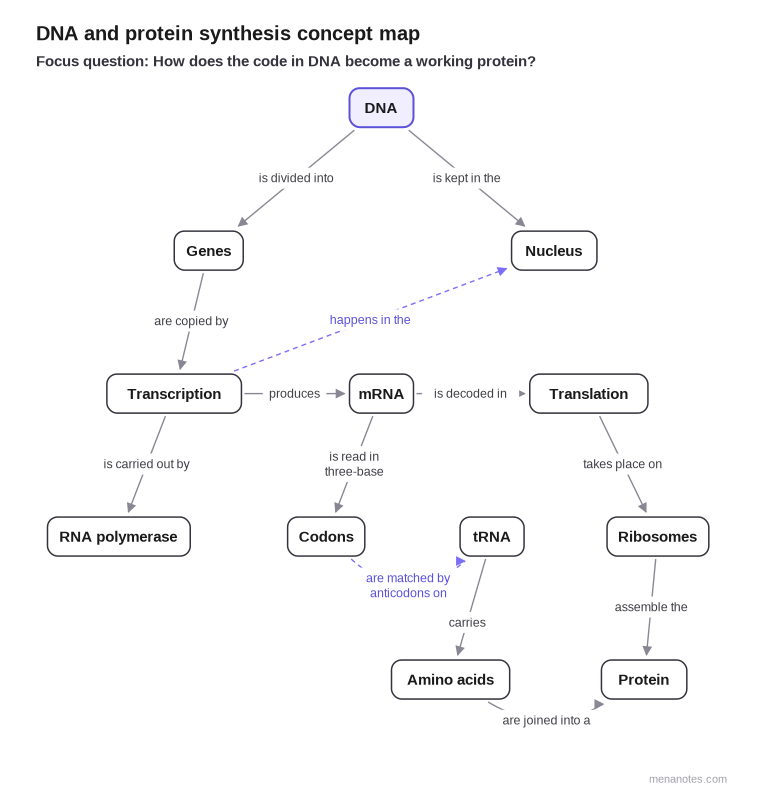
- Nucleus stores DNA
- Eukaryotic cells are filled with Cytoplasm
- Cytoplasm holds Mitochondria
- Cytoplasm holds Ribosomes
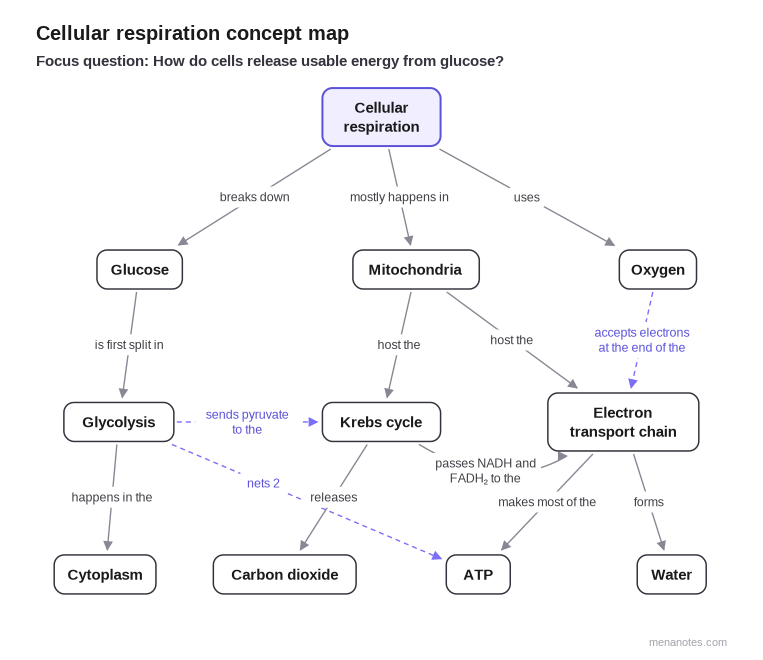
- Mitochondria carry out Cellular respiration
- Ribosomes build Proteins
- DNA carries the code for Proteins
- Eukaryotic cells include Plant cells
- Eukaryotic cells include Animal cells
- Plant cells also have Chloroplasts
- Plant cells also have a Cell wall
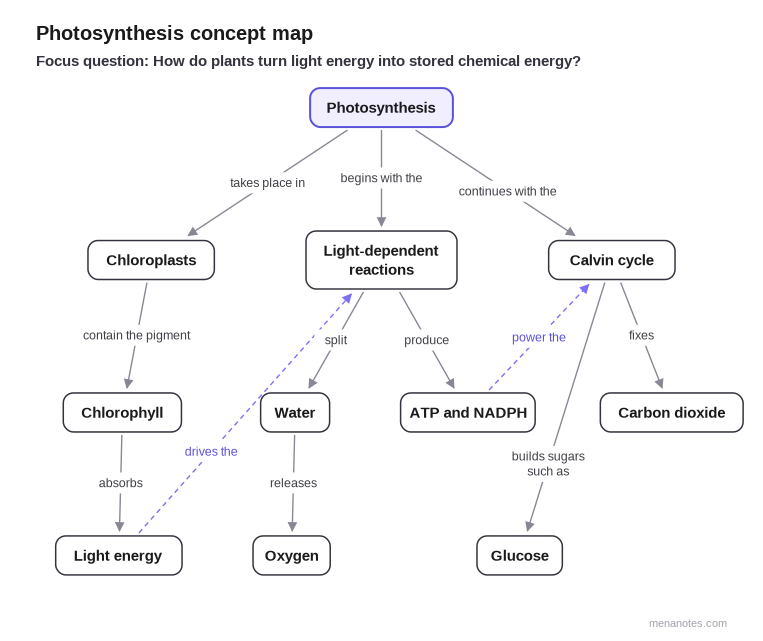
- Chloroplasts carry out Photosynthesis
- Cell wall is made of Cellulose
- Animal cells lack a Cell wall
Cell structure: what the map shows
Every eukaryotic cell has a cell membrane, a nucleus and cytoplasm. The membrane is selectively permeable: it lets some substances through and keeps others out. The nucleus holds the DNA that carries instructions for making proteins, and ribosomes in the cytoplasm read those instructions and build them.
Mitochondria release energy from glucose by cellular respiration, so they are found in both plant and animal cells. Plant cells add a cellulose cell wall for support, chloroplasts for photosynthesis and usually one large permanent vacuole filled with cell sap.
Common mistakes
- Plant cells have mitochondria too. Chloroplasts make sugar; mitochondria still release its energy.
- The cell wall does not replace the cell membrane. Plant cells have both, with the wall outside the membrane.
Make it your own
Drawing the map yourself is where the learning happens. Start from the focus question, list the concepts first, then link them with your own words. A blank concept map template gives you the boxes; the concept map guide covers the method.
Make and edit this map in Mena on iPad
Mena is a canvas app for iPad, iPhone and Mac, free to start. Paste this map in, rearrange it, add your own notes and sketches, and turn concepts into flashcards.
Get Mena on the App Store- Copy this map as text.
- In a Mena board, open More tools in the toolbar, choose Diagram from Text and paste. Each concept becomes a shape and each linking phrase a connector label.
- Drag concepts around, rename linking phrases and draw your own cross-links. Connectors stay attached when you move a shape.
- Export the finished board as PNG, SVG or PDF.