Heart failure nursing concept map
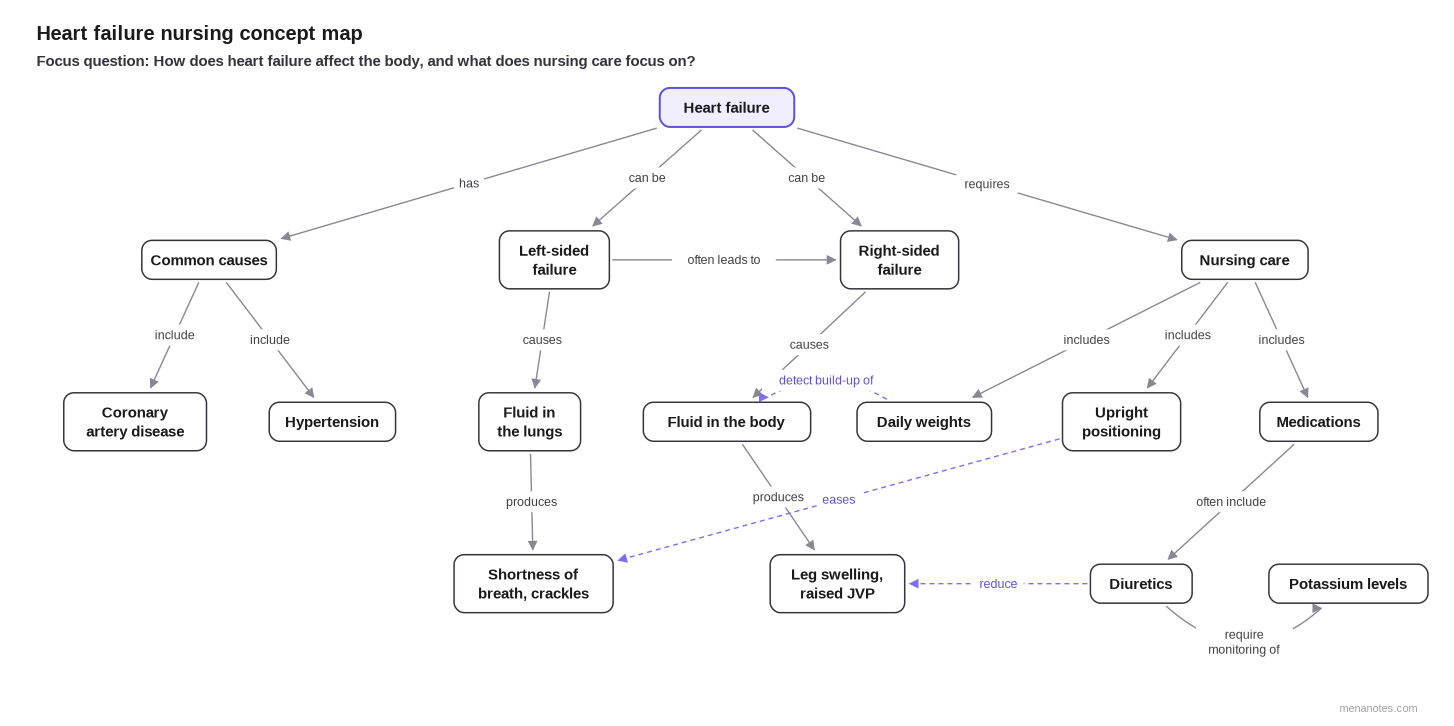
In heart failure the heart cannot pump enough blood to meet the body’s needs, so fluid backs up behind the failing side. This study map links the type of failure to its signs and to the nursing care that targets each.
Read the map as sentences
Every arrow is a proposition. Read aloud, the map says:
- Heart failure has Common causes
- Heart failure can be Left-sided failure
- Heart failure can be Right-sided failure
- Heart failure requires Nursing care
- Common causes include Coronary artery disease
- Common causes include Hypertension
- Left-sided failure causes Fluid in the lungs
- Right-sided failure causes Fluid in the body
- Left-sided failure often leads to Right-sided failure
- Fluid in the lungs produces Shortness of breath, crackles
- Fluid in the body produces Leg swelling, raised JVP
- Nursing care includes Daily weights
- Nursing care includes Upright positioning
- Nursing care includes Medications
- Daily weights detect build-up of Fluid in the body
- Upright positioning eases Shortness of breath, crackles
- Medications often include Diuretics
- Diuretics reduce Leg swelling, raised JVP
- Diuretics require monitoring of Potassium levels
Heart failure nursing: what the map shows
Coronary artery disease and long-standing hypertension are among the most common causes. When the left ventricle fails, blood backs up into the lungs, causing shortness of breath, breathlessness lying flat and crackles. When the right ventricle fails, fluid backs up into the body, causing leg and ankle swelling, a raised jugular venous pressure and weight gain. Left-sided failure is the most common cause of right-sided failure.
Daily weights, taken at the same time on the same scale, are one of the earliest signs of fluid retention. Sitting the patient upright eases breathing. Medications often include diuretics to remove fluid, which means monitoring potassium and kidney function, alongside drugs that protect the heart long term.
Common mistakes
- Rapid weight gain over a day or two is usually fluid, not fat.
- Swollen ankles point to right-sided congestion; lung crackles point to left-sided congestion.
A study aid for learning how the concepts connect, not clinical guidance. Follow your programme’s care-plan format and your facility’s protocols in practice.
Make it your own
Drawing the map yourself is where the learning happens. Start from the focus question, list the concepts first, then link them with your own words. A blank concept map template gives you the boxes; the concept map guide covers the method.
Make and edit this map in Mena on iPad
Mena is a canvas app for iPad, iPhone and Mac, free to start. Paste this map in, rearrange it, add your own notes and sketches, and turn concepts into flashcards.
Get Mena on the App Store- Copy this map as text.
- In a Mena board, open More tools in the toolbar, choose Diagram from Text and paste. Each concept becomes a shape and each linking phrase a connector label.
- Drag concepts around, rename linking phrases and draw your own cross-links. Connectors stay attached when you move a shape.
- Export the finished board as PNG, SVG or PDF.