Supply and demand concept map
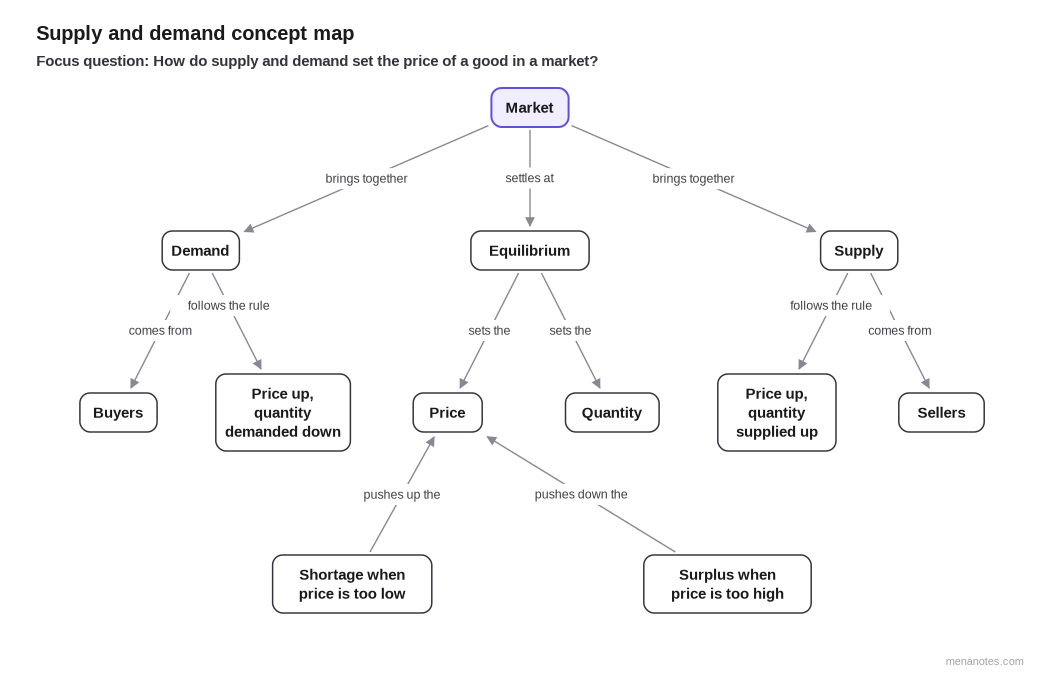
In a competitive market, price is set where the amount buyers want matches the amount sellers offer. This map links demand and supply to that equilibrium and shows what pushes price back towards it.
Read the map as sentences
Every arrow is a proposition. Read aloud, the map says:
- Market brings together Demand
- Market brings together Supply
- Market settles at Equilibrium
- Demand comes from Buyers
- Demand follows the rule Price up, quantity demanded down
- Supply comes from Sellers
- Supply follows the rule Price up, quantity supplied up
- Equilibrium sets the Price
- Equilibrium sets the Quantity
- Shortage when price is too low pushes up the Price
- Surplus when price is too high pushes down the Price
Supply and demand: what the map shows
Demand is how much of a good buyers are willing and able to buy at each price. The law of demand says that, other things equal, a higher price means a lower quantity demanded. Supply is how much sellers will offer; the law of supply says a higher price means a higher quantity supplied.
Equilibrium is the price at which quantity demanded equals quantity supplied. Below it, buyers want more than sellers offer, and the shortage pushes the price up. Above it, unsold stock builds up, and the surplus pushes the price down.
A change in something other than price, such as income, tastes or production costs, shifts a whole curve and moves the equilibrium.
Common mistakes
- A change in price moves along a curve; it does not shift demand or supply.
- Equilibrium is not a fair price or a fixed one; it changes whenever demand or supply shifts.
Make it your own
Drawing the map yourself is where the learning happens. Start from the focus question, list the concepts first, then link them with your own words. A blank concept map template gives you the boxes; the concept map guide covers the method.
Make and edit this map in Mena on iPad
Mena is a canvas app for iPad, iPhone and Mac, free to start. Paste this map in, rearrange it, add your own notes and sketches, and turn concepts into flashcards.
Get Mena on the App Store- Copy this map as text.
- In a Mena board, open More tools in the toolbar, choose Diagram from Text and paste. Each concept becomes a shape and each linking phrase a connector label.
- Drag concepts around, rename linking phrases and draw your own cross-links. Connectors stay attached when you move a shape.
- Export the finished board as PNG, SVG or PDF.