
Newton’s laws of motion concept map
Isaac Newton’s three laws, published in 1687, describe how forces affect motion. This map links each law to the quantities it connects, so you can see how they work together.
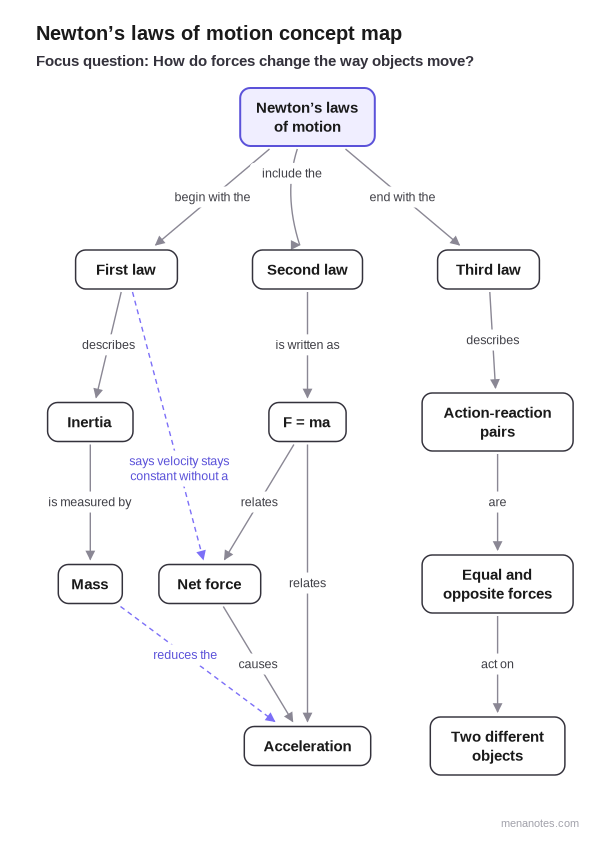
Read the map as sentences
Every arrow is a proposition. Read aloud, the map says:
- Newton’s laws of motion begin with the First law
- Newton’s laws of motion include the Second law
- Newton’s laws of motion end with the Third law
- First law describes Inertia
- First law says velocity stays constant without a Net force
- Second law is written as F = ma
- F = ma relates Net force
- F = ma relates Acceleration
- Inertia is measured by Mass
- Net force causes Acceleration
- Mass reduces the Acceleration
- Third law describes Action-reaction pairs
- Action-reaction pairs are Equal and opposite forces
- Equal and opposite forces act on Two different objects
Newton’s laws of motion: what the map shows
First law: an object stays at rest or keeps moving at a constant velocity unless a net (unbalanced) force acts on it. This resistance to change in motion is inertia, and mass is its measure.
Second law: the acceleration of an object equals the net force on it divided by its mass, usually written F = ma. Double the force and the acceleration doubles; double the mass and it halves. Force is measured in newtons.
Third law: when one object pushes on another, the second pushes back with a force equal in size and opposite in direction. The two forces act on different objects, which is why they do not cancel out.
Common mistakes
- A moving object does not need a force to keep moving; it needs one to speed up, slow down or turn.
- Action and reaction forces never act on the same object, so they cannot balance each other.
Make it your own
Drawing the map yourself is where the learning happens. Start from the focus question, list the concepts first, then link them with your own words. A blank concept map template gives you the boxes; the concept map guide covers the method.
Make and edit this map in Mena on iPad
Mena is a canvas app for iPad, iPhone and Mac, free to start. Paste this map in, rearrange it, add your own notes and sketches, and turn concepts into flashcards.
Get Mena on the App Store- Copy this map as text.
- In a Mena board, open More tools in the toolbar, choose Diagram from Text and paste. Each concept becomes a shape and each linking phrase a connector label.
- Drag concepts around, rename linking phrases and draw your own cross-links. Connectors stay attached when you move a shape.
- Export the finished board as PNG, SVG or PDF.
More concept map examples
-
 Physics
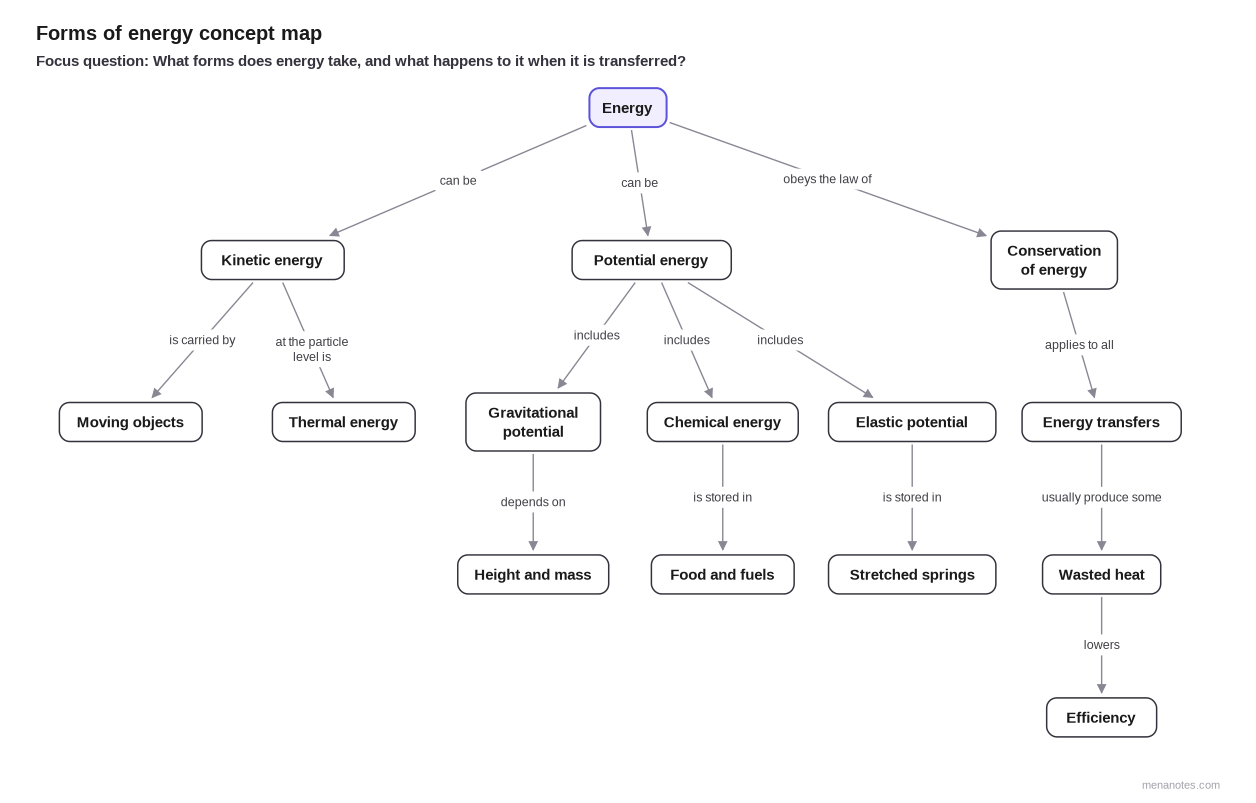
Forms of energy concept map
What forms does energy take, and what happens to it when it is transferred?
-
 Physics
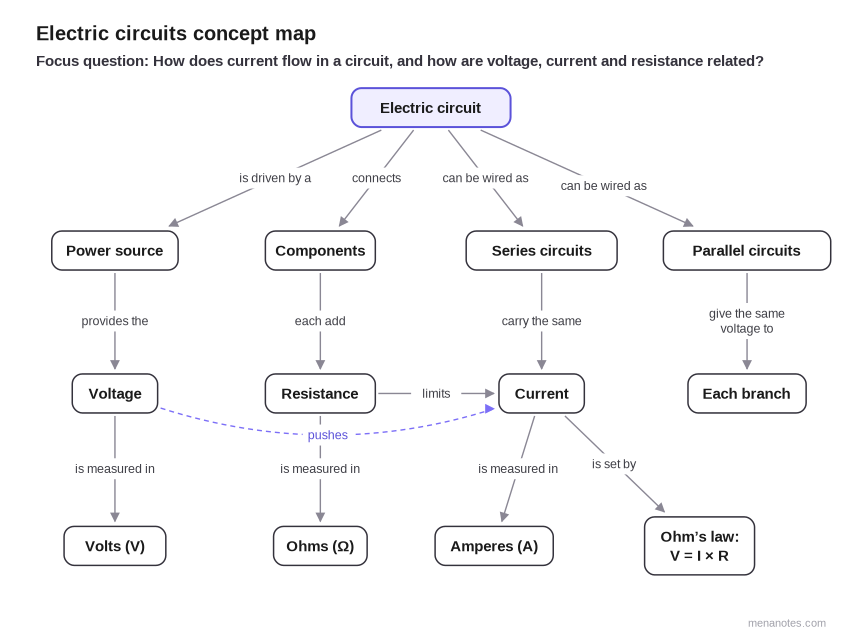
Electric circuits concept map
How does current flow in a circuit, and how are voltage, current and resistance related?
-
 Biology
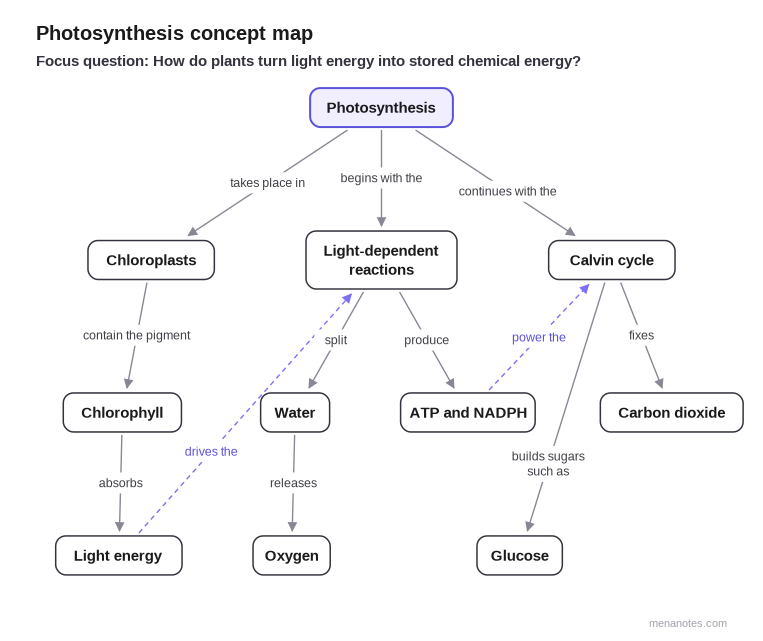
Photosynthesis concept map
How do plants turn light energy into stored chemical energy?