
Forms of energy concept map
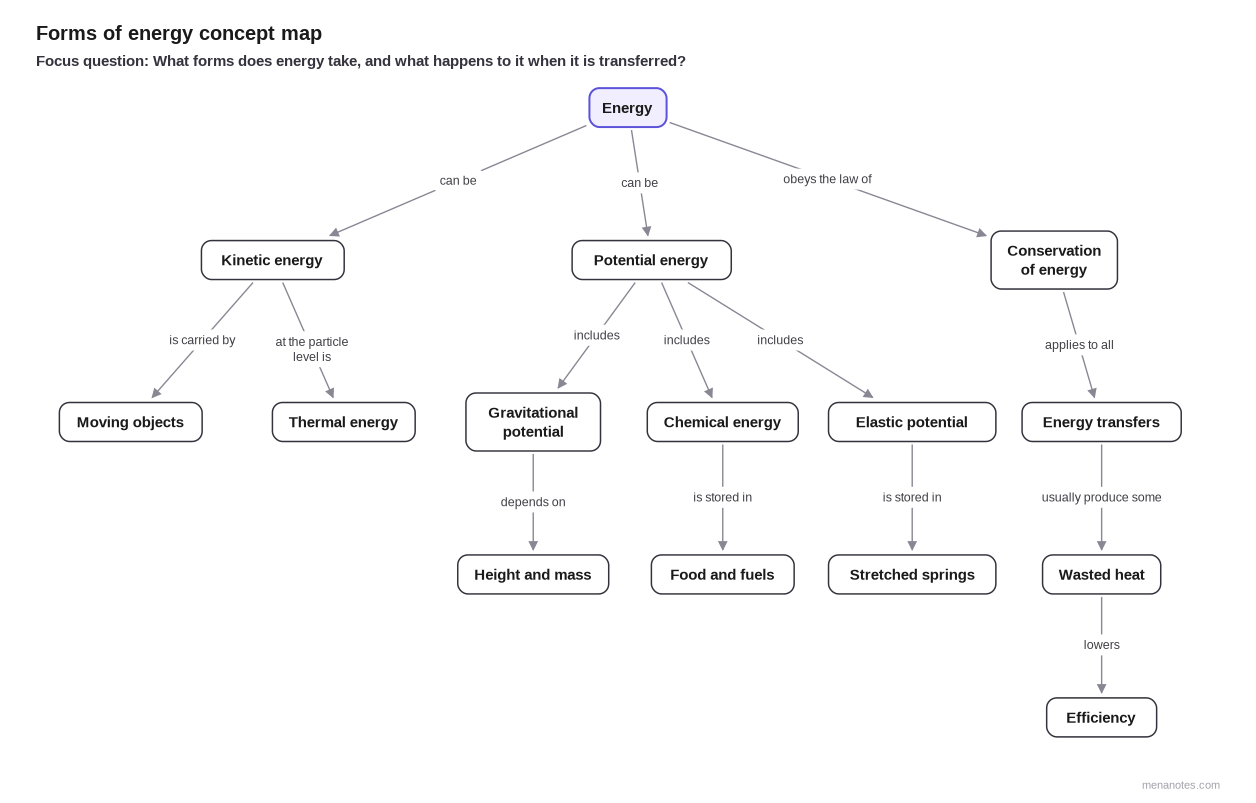
Energy is never made or destroyed; it is transferred from one form or store to another. This map sorts the main forms into kinetic and potential energy and links them to conservation and efficiency.
Read the map as sentences
Every arrow is a proposition. Read aloud, the map says:
- Energy can be Kinetic energy
- Energy can be Potential energy
- Energy obeys the law of Conservation of energy
- Kinetic energy is carried by Moving objects
- Kinetic energy at the particle level is Thermal energy
- Potential energy includes Gravitational potential
- Potential energy includes Chemical energy
- Potential energy includes Elastic potential
- Gravitational potential depends on Height and mass
- Chemical energy is stored in Food and fuels
- Elastic potential is stored in Stretched springs
- Conservation of energy applies to all Energy transfers
- Energy transfers usually produce some Wasted heat
- Wasted heat lowers Efficiency
Forms of energy: what the map shows
Kinetic energy is the energy of motion, KE = ½mv². Thermal energy is the kinetic energy of the particles inside a substance, which is why hotter objects have faster-moving particles.
Potential energy is stored energy. Gravitational potential energy depends on mass and height (GPE = mgh), elastic potential energy is stored in stretched or squashed objects, and chemical energy is stored in the bonds of food and fuels.
The law of conservation of energy says the total stays the same in every transfer. In practice some energy always spreads out as heat that is hard to use, and efficiency is the share of input energy that ends up as useful output.
Common mistakes
- Energy is not used up; it is transferred and often spread out as heat.
- Heat and temperature are different. Temperature measures how hot something is; thermal energy also depends on how much of it there is.
Make it your own
Drawing the map yourself is where the learning happens. Start from the focus question, list the concepts first, then link them with your own words. A blank concept map template gives you the boxes; the concept map guide covers the method.
Make and edit this map in Mena on iPad
Mena is a canvas app for iPad, iPhone and Mac, free to start. Paste this map in, rearrange it, add your own notes and sketches, and turn concepts into flashcards.
Get Mena on the App Store- Copy this map as text.
- In a Mena board, open More tools in the toolbar, choose Diagram from Text and paste. Each concept becomes a shape and each linking phrase a connector label.
- Drag concepts around, rename linking phrases and draw your own cross-links. Connectors stay attached when you move a shape.
- Export the finished board as PNG, SVG or PDF.
More concept map examples
-
 Physics
Newton’s laws of motion concept map
How do forces change the way objects move?
-
 Physics
Electric circuits concept map
How does current flow in a circuit, and how are voltage, current and resistance related?
-
 Biology
Photosynthesis concept map
How do plants turn light energy into stored chemical energy?