Natural selection concept map
Natural selection is the main mechanism of evolution, described by Charles Darwin and Alfred Russel Wallace in 1858. This map links its ingredients, from variation to new species, as a chain of cause and effect.
Read the map as sentences
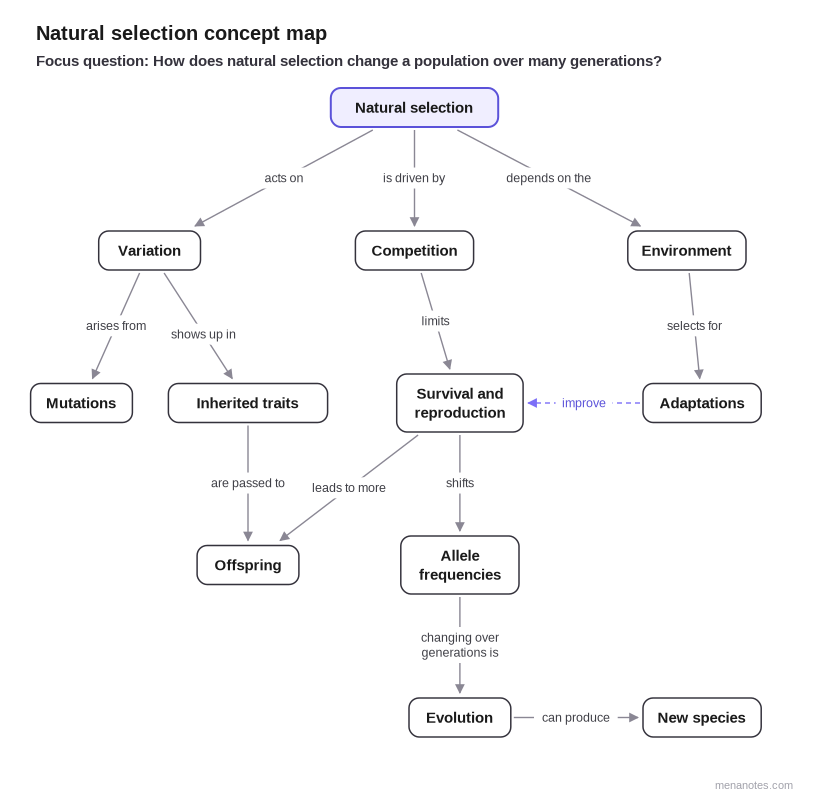
Every arrow is a proposition. Read aloud, the map says:
- Natural selection acts on Variation
- Natural selection is driven by Competition
- Natural selection depends on the Environment
- Variation arises from Mutations
- Variation shows up in Inherited traits
- Competition limits Survival and reproduction
- Environment selects for Adaptations
- Adaptations improve Survival and reproduction
- Inherited traits are passed to Offspring
- Survival and reproduction leads to more Offspring
- Survival and reproduction shifts Allele frequencies
- Allele frequencies changing over generations is Evolution
- Evolution can produce New species
Natural selection: what the map shows
Individuals in a population vary, and some of that variation is inherited. New variants arise from mutations and are reshuffled by sexual reproduction.
More offspring are produced than the environment can support, so individuals compete for food, mates and space. Those with traits better suited to the environment are more likely to survive and reproduce, passing those traits on.
Over many generations this shifts how common each allele is in the population. That change is evolution, and when populations become separated and change enough, they can form new species.
Common mistakes
- Individuals do not evolve; populations do, over generations.
- Organisms do not develop traits because they need them. The variation exists first and the environment selects among it.
Make it your own
Drawing the map yourself is where the learning happens. Start from the focus question, list the concepts first, then link them with your own words. A blank concept map template gives you the boxes; the concept map guide covers the method.
Make and edit this map in Mena on iPad
Mena is a canvas app for iPad, iPhone and Mac, free to start. Paste this map in, rearrange it, add your own notes and sketches, and turn concepts into flashcards.
Get Mena on the App Store- Copy this map as text.
- In a Mena board, open More tools in the toolbar, choose Diagram from Text and paste. Each concept becomes a shape and each linking phrase a connector label.
- Drag concepts around, rename linking phrases and draw your own cross-links. Connectors stay attached when you move a shape.
- Export the finished board as PNG, SVG or PDF.