Industrial Revolution concept map
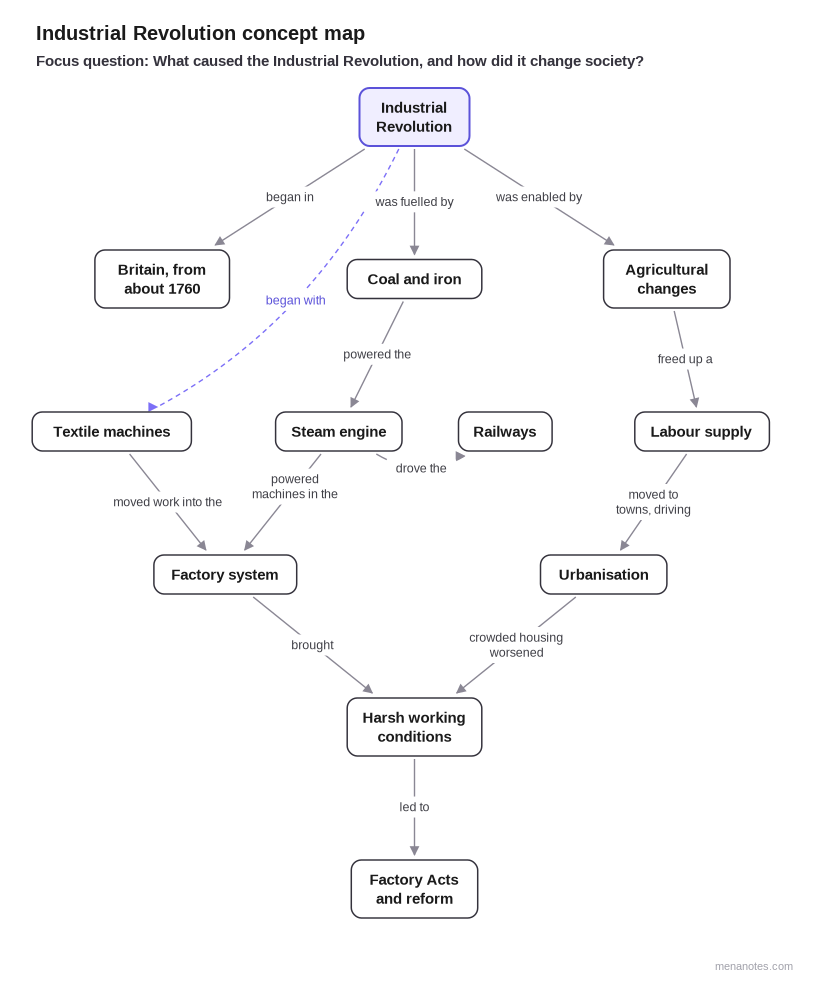
The Industrial Revolution was the shift from hand production to machines and factories that began in Britain in the second half of the 18th century. This map links its causes, its key technologies and its effects on work and cities.
Read the map as sentences
Every arrow is a proposition. Read aloud, the map says:
- Industrial Revolution began in Britain, from about 1760
- Industrial Revolution was fuelled by Coal and iron
- Industrial Revolution was enabled by Agricultural changes
- Industrial Revolution began with Textile machines
- Coal and iron powered the Steam engine
- Steam engine drove the Railways
- Agricultural changes freed up a Labour supply
- Textile machines moved work into the Factory system
- Steam engine powered machines in the Factory system
- Labour supply moved to towns, driving Urbanisation
- Factory system brought Harsh working conditions
- Urbanisation crowded housing worsened Harsh working conditions
- Harsh working conditions led to Factory Acts and reform
Industrial Revolution: what the map shows
Britain had coal and iron ore, capital from trade, a growing population and farms that produced more food with fewer workers. Textiles were the first industry to mechanise, with inventions such as Hargreaves’s spinning jenny and Arkwright’s water frame in the 1760s.
James Watt’s improved steam engine, patented in 1769, freed factories from rivers and later drove locomotives. The Stockton and Darlington Railway opened in 1825 and the Liverpool and Manchester Railway in 1830.
Factories drew workers into fast-growing towns with crowded, unsanitary housing. Long hours and child labour led to reforms such as the Factory Act of 1833, which limited children’s working hours in textile mills.
Common mistakes
- Watt did not invent the steam engine. Newcomen’s engine came first; Watt made it far more efficient.
- Industrialisation did not happen everywhere at once; it spread from Britain to Europe and the United States through the 19th century.
Make it your own
Drawing the map yourself is where the learning happens. Start from the focus question, list the concepts first, then link them with your own words. A blank concept map template gives you the boxes; the concept map guide covers the method.
Make and edit this map in Mena on iPad
Mena is a canvas app for iPad, iPhone and Mac, free to start. Paste this map in, rearrange it, add your own notes and sketches, and turn concepts into flashcards.
Get Mena on the App Store- Copy this map as text.
- In a Mena board, open More tools in the toolbar, choose Diagram from Text and paste. Each concept becomes a shape and each linking phrase a connector label.
- Drag concepts around, rename linking phrases and draw your own cross-links. Connectors stay attached when you move a shape.
- Export the finished board as PNG, SVG or PDF.