Causes of World War I concept map
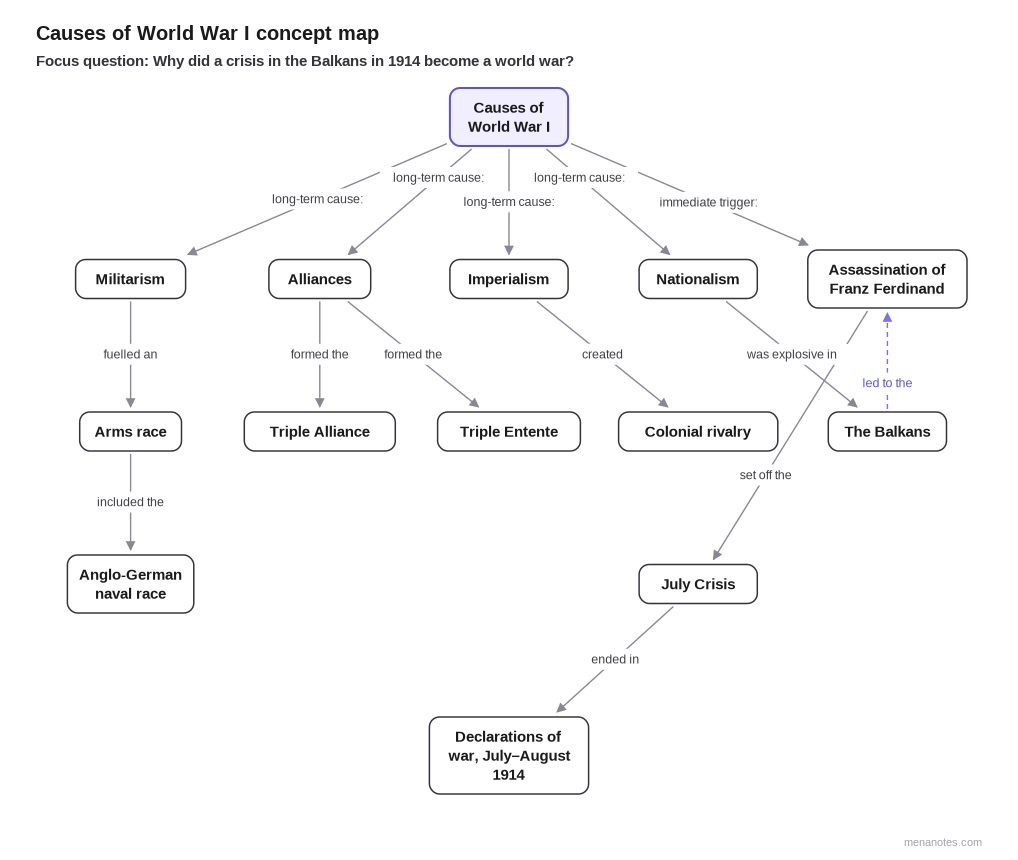
Historians often group the long-term causes of the First World War as militarism, alliances, imperialism and nationalism, with the assassination of Archduke Franz Ferdinand as the trigger. This map links them to show how a regional crisis spread.
Read the map as sentences
Every arrow is a proposition. Read aloud, the map says:
- Causes of World War I long-term cause: Militarism
- Causes of World War I long-term cause: Alliances
- Causes of World War I long-term cause: Imperialism
- Causes of World War I long-term cause: Nationalism
- Causes of World War I immediate trigger: Assassination of Franz Ferdinand
- Militarism fuelled an Arms race
- Arms race included the Anglo-German naval race
- Alliances formed the Triple Alliance
- Alliances formed the Triple Entente
- Imperialism created Colonial rivalry
- Nationalism was explosive in The Balkans
- The Balkans led to the Assassination of Franz Ferdinand
- Assassination of Franz Ferdinand set off the July Crisis
- July Crisis ended in Declarations of war, July–August 1914
Causes of World War I: what the map shows
By 1914 Europe was split into two armed camps: the Triple Alliance of Germany, Austria-Hungary and Italy, and the Triple Entente of France, Russia and Britain. Military planning, a naval race between Britain and Germany after the launch of HMS Dreadnought in 1906, and rivalry over colonies raised tension.
On 28 June 1914, Gavrilo Princip, a Bosnian Serb nationalist, shot Archduke Franz Ferdinand, heir to the Austro-Hungarian throne, in Sarajevo. In the July Crisis that followed, Austria-Hungary issued an ultimatum to Serbia, backed by Germany, and declared war on 28 July.
The alliances then pulled in the great powers. Russia mobilised, Germany declared war on Russia and France and invaded Belgium, and Britain declared war on Germany on 4 August 1914.
Common mistakes
- Italy was in the Triple Alliance but stayed neutral in 1914 and joined the Allies in 1915.
- The assassination was the trigger, not the whole cause; most historians weigh several long-term factors.
Make it your own
Drawing the map yourself is where the learning happens. Start from the focus question, list the concepts first, then link them with your own words. A blank concept map template gives you the boxes; the concept map guide covers the method.
Make and edit this map in Mena on iPad
Mena is a canvas app for iPad, iPhone and Mac, free to start. Paste this map in, rearrange it, add your own notes and sketches, and turn concepts into flashcards.
Get Mena on the App Store- Copy this map as text.
- In a Mena board, open More tools in the toolbar, choose Diagram from Text and paste. Each concept becomes a shape and each linking phrase a connector label.
- Drag concepts around, rename linking phrases and draw your own cross-links. Connectors stay attached when you move a shape.
- Export the finished board as PNG, SVG or PDF.