Ecosystem concept map
An ecosystem is a community of organisms together with the physical environment they live in. This map links the living (biotic) and non-living (abiotic) parts and shows how energy flows through it while nutrients go round.
Read the map as sentences
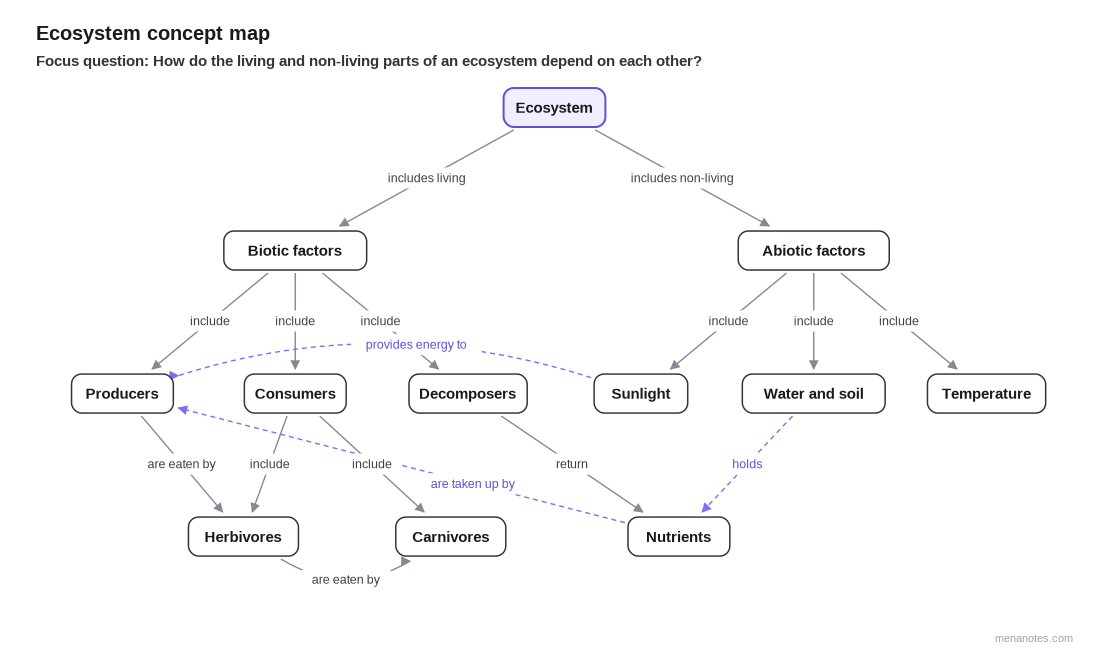
Every arrow is a proposition. Read aloud, the map says:
- Ecosystem includes living Biotic factors
- Ecosystem includes non-living Abiotic factors
- Biotic factors include Producers
- Biotic factors include Consumers
- Biotic factors include Decomposers
- Abiotic factors include Sunlight
- Abiotic factors include Water and soil
- Abiotic factors include Temperature
- Sunlight provides energy to Producers
- Consumers include Herbivores
- Consumers include Carnivores
- Producers are eaten by Herbivores
- Herbivores are eaten by Carnivores
- Decomposers return Nutrients
- Water and soil holds Nutrients
- Nutrients are taken up by Producers
Ecosystem: what the map shows
Producers, mostly plants and algae, capture light energy by photosynthesis. Consumers get energy by eating: herbivores eat producers and carnivores eat other consumers. Decomposers such as bacteria and fungi break down dead matter and waste.
Energy flows one way. At each feeding level most of it is used for life processes or lost as heat, and only a small share, often given as about 10 percent, passes to the next level. That is why food chains rarely have more than four or five links.
Nutrients such as nitrogen and carbon cycle instead of flowing. Decomposers return them to the soil and air, where producers take them up again.
Common mistakes
- Energy is not recycled in an ecosystem; nutrients are.
- Decomposers are not the same as scavengers. Scavengers eat dead animals; decomposers break organic matter down chemically.
Make it your own
Drawing the map yourself is where the learning happens. Start from the focus question, list the concepts first, then link them with your own words. A blank concept map template gives you the boxes; the concept map guide covers the method.
Make and edit this map in Mena on iPad
Mena is a canvas app for iPad, iPhone and Mac, free to start. Paste this map in, rearrange it, add your own notes and sketches, and turn concepts into flashcards.
Get Mena on the App Store- Copy this map as text.
- In a Mena board, open More tools in the toolbar, choose Diagram from Text and paste. Each concept becomes a shape and each linking phrase a connector label.
- Drag concepts around, rename linking phrases and draw your own cross-links. Connectors stay attached when you move a shape.
- Export the finished board as PNG, SVG or PDF.