
States of matter concept map
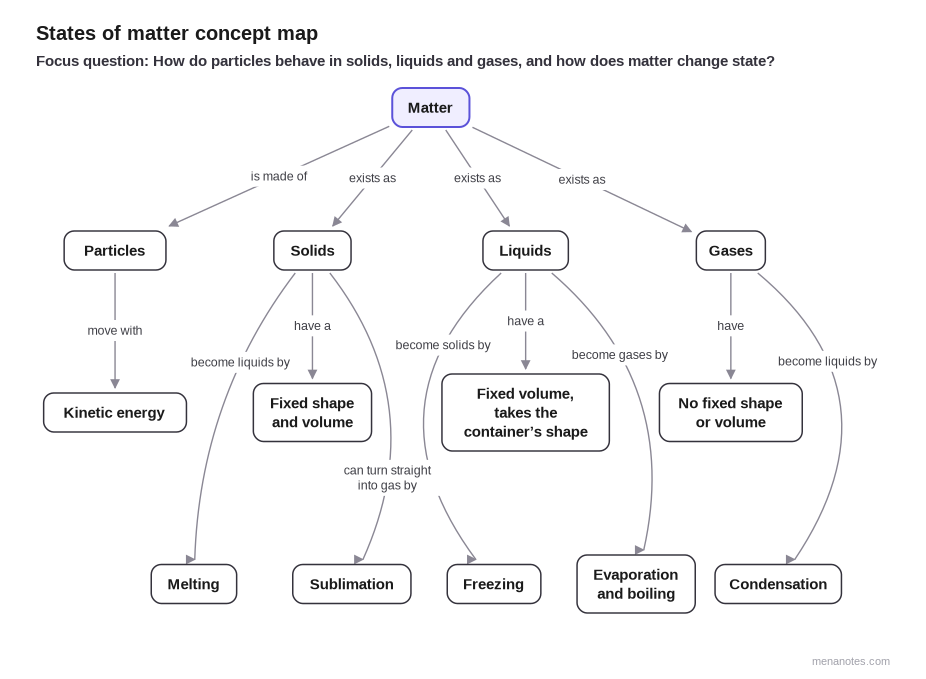
Matter is made of particles, and how those particles are arranged and how much energy they have decides whether it is a solid, a liquid or a gas. This map links each state to its properties and to the changes between them.
Read the map as sentences
Every arrow is a proposition. Read aloud, the map says:
- Matter is made of Particles
- Matter exists as Solids
- Matter exists as Liquids
- Matter exists as Gases
- Particles move with Kinetic energy
- Solids have a Fixed shape and volume
- Liquids have a Fixed volume, takes the container’s shape
- Gases have No fixed shape or volume
- Solids become liquids by Melting
- Solids can turn straight into gas by Sublimation
- Liquids become solids by Freezing
- Liquids become gases by Evaporation and boiling
- Gases become liquids by Condensation
States of matter: what the map shows
In a solid, particles are packed in a regular pattern and only vibrate, so the shape and volume are fixed. In a liquid they are still close together but can slide past each other, so a liquid flows. In a gas they are far apart and move quickly in all directions, filling any container.
Heating gives particles more kinetic energy. At the melting point a solid becomes a liquid; at the boiling point a liquid becomes a gas throughout. Evaporation also happens below boiling point, from the surface only. Cooling reverses each change.
Some solids, such as dry ice (solid carbon dioxide), sublime straight into a gas. Plasma, an ionised gas found in stars and lightning, is often taught as a fourth state.
Common mistakes
- Particles do not expand when a substance is heated; the spaces between them grow.
- Temperature stays constant during melting and boiling, because the energy goes into separating particles.
Make it your own
Drawing the map yourself is where the learning happens. Start from the focus question, list the concepts first, then link them with your own words. A blank concept map template gives you the boxes; the concept map guide covers the method.
Make and edit this map in Mena on iPad
Mena is a canvas app for iPad, iPhone and Mac, free to start. Paste this map in, rearrange it, add your own notes and sketches, and turn concepts into flashcards.
Get Mena on the App Store- Copy this map as text.
- In a Mena board, open More tools in the toolbar, choose Diagram from Text and paste. Each concept becomes a shape and each linking phrase a connector label.
- Drag concepts around, rename linking phrases and draw your own cross-links. Connectors stay attached when you move a shape.
- Export the finished board as PNG, SVG or PDF.
More concept map examples
-
 Chemistry
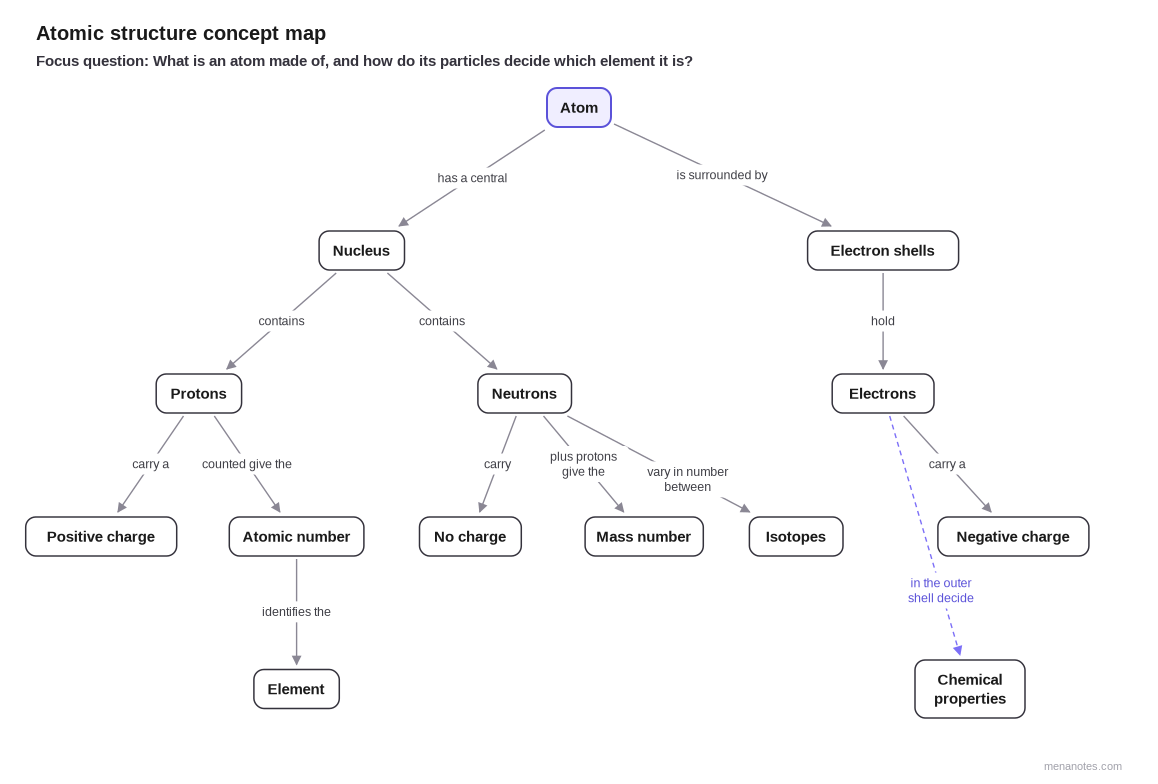
Atomic structure concept map
What is an atom made of, and how do its particles decide which element it is?
-
 Chemistry
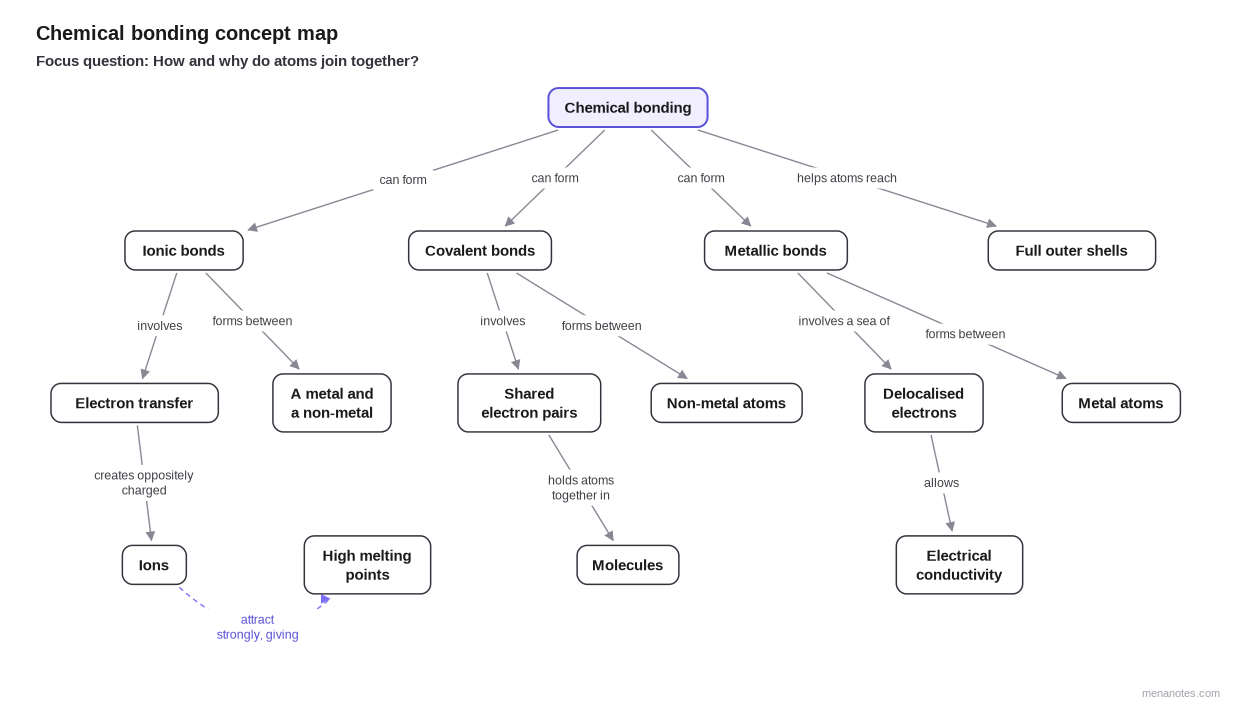
Chemical bonding concept map
How and why do atoms join together?
-
 Chemistry
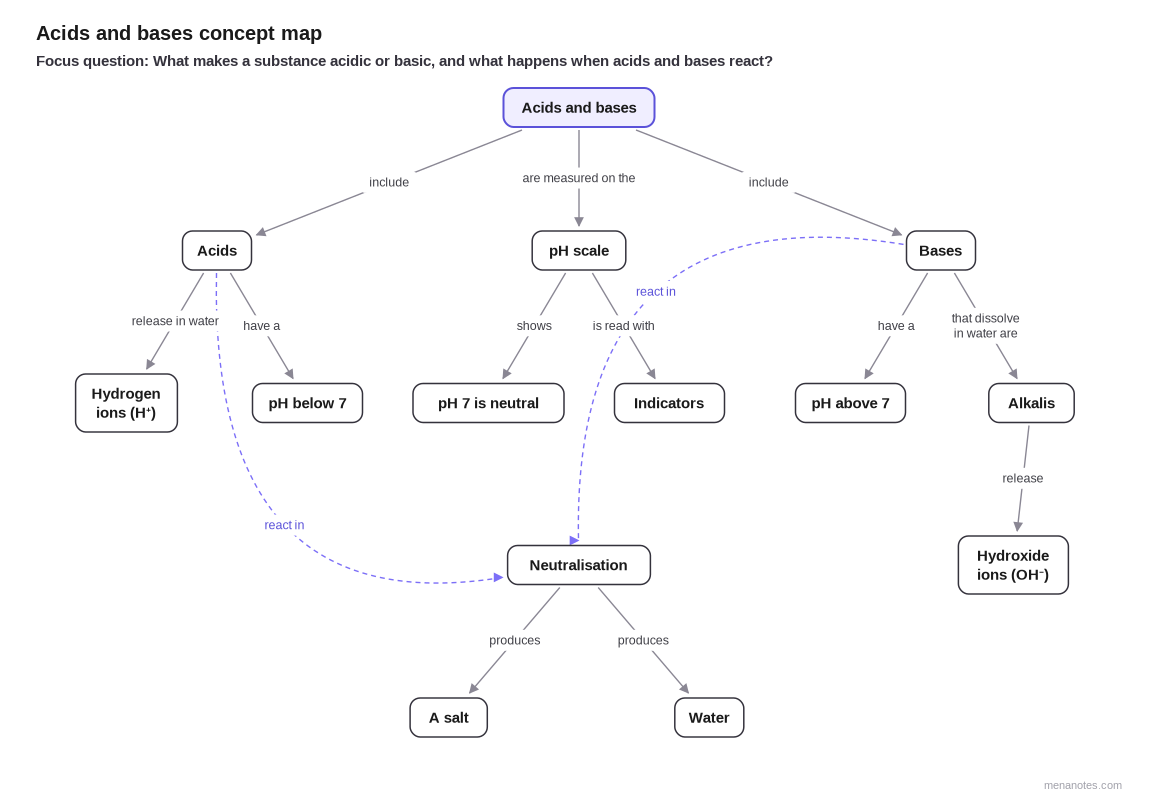
Acids and bases concept map
What makes a substance acidic or basic, and what happens when acids and bases react?