
Chemical bonding concept map
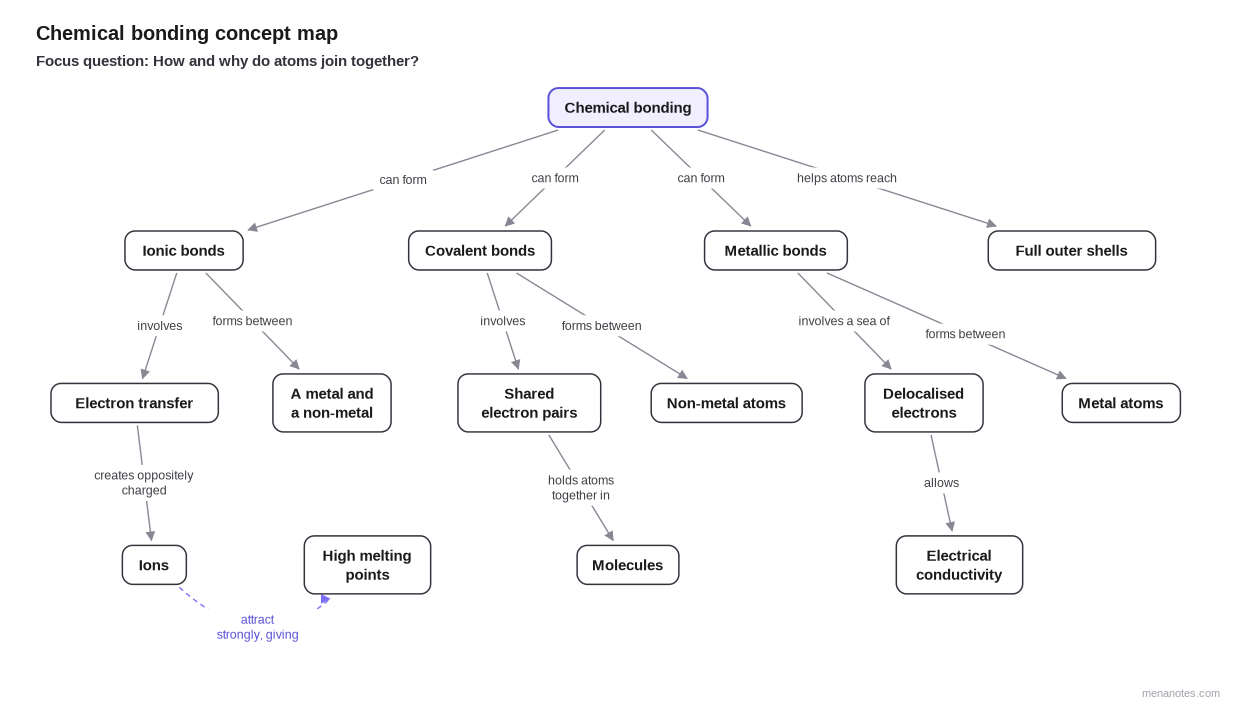
Atoms bond by transferring or sharing electrons, usually ending up with a more stable arrangement. This map compares the three main bond types, which atoms form them and what properties result.
Read the map as sentences
Every arrow is a proposition. Read aloud, the map says:
- Chemical bonding can form Ionic bonds
- Chemical bonding can form Covalent bonds
- Chemical bonding can form Metallic bonds
- Chemical bonding helps atoms reach Full outer shells
- Ionic bonds involves Electron transfer
- Ionic bonds forms between A metal and a non-metal
- Electron transfer creates oppositely charged Ions
- Ions attract strongly, giving High melting points
- Covalent bonds involves Shared electron pairs
- Covalent bonds forms between Non-metal atoms
- Shared electron pairs holds atoms together in Molecules
- Metallic bonds involves a sea of Delocalised electrons
- Metallic bonds forms between Metal atoms
- Delocalised electrons allows Electrical conductivity
Chemical bonding: what the map shows
In an ionic bond, a metal atom transfers electrons to a non-metal atom. The metal becomes a positive ion and the non-metal a negative ion, and the strong attraction between them builds a giant lattice, as in sodium chloride. Ionic compounds have high melting points and conduct electricity when molten or dissolved.
In a covalent bond, two non-metal atoms share a pair of electrons. Most covalent substances form small molecules with low melting points, such as water and carbon dioxide; a few form giant structures, such as diamond.
In a metallic bond, metal ions sit in a sea of delocalised electrons. Those free electrons let metals conduct electricity and heat.
Common mistakes
- A covalent bond inside a molecule is strong; low melting points come from weak forces between molecules.
- Solid ionic compounds do not conduct, because their ions cannot move.
Make it your own
Drawing the map yourself is where the learning happens. Start from the focus question, list the concepts first, then link them with your own words. A blank concept map template gives you the boxes; the concept map guide covers the method.
Make and edit this map in Mena on iPad
Mena is a canvas app for iPad, iPhone and Mac, free to start. Paste this map in, rearrange it, add your own notes and sketches, and turn concepts into flashcards.
Get Mena on the App Store- Copy this map as text.
- In a Mena board, open More tools in the toolbar, choose Diagram from Text and paste. Each concept becomes a shape and each linking phrase a connector label.
- Drag concepts around, rename linking phrases and draw your own cross-links. Connectors stay attached when you move a shape.
- Export the finished board as PNG, SVG or PDF.
More concept map examples
-
 Chemistry
States of matter concept map
How do particles behave in solids, liquids and gases, and how does matter change state?
-
 Chemistry
Atomic structure concept map
What is an atom made of, and how do its particles decide which element it is?
-
 Chemistry
Acids and bases concept map
What makes a substance acidic or basic, and what happens when acids and bases react?