
Rock cycle concept map
The rock cycle describes how the three rock types form and turn into one another over geological time. This map links each type to the processes that create it and the ones that destroy it.
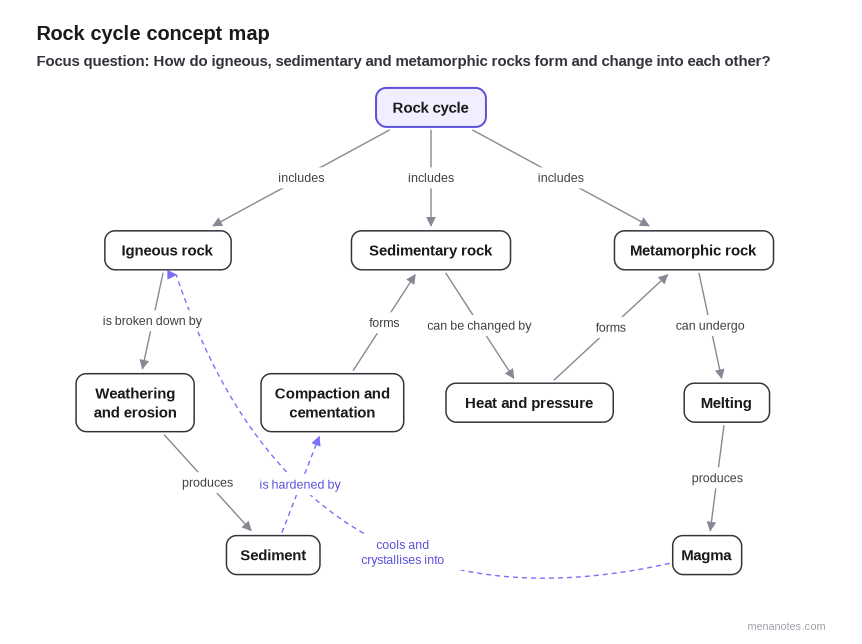
Read the map as sentences
Every arrow is a proposition. Read aloud, the map says:
- Rock cycle includes Igneous rock
- Rock cycle includes Sedimentary rock
- Rock cycle includes Metamorphic rock
- Igneous rock is broken down by Weathering and erosion
- Weathering and erosion produces Sediment
- Sediment is hardened by Compaction and cementation
- Compaction and cementation forms Sedimentary rock
- Sedimentary rock can be changed by Heat and pressure
- Heat and pressure forms Metamorphic rock
- Metamorphic rock can undergo Melting
- Melting produces Magma
- Magma cools and crystallises into Igneous rock
Rock cycle: what the map shows
Igneous rock forms when magma or lava cools and crystallises. Slow cooling underground gives large crystals, as in granite; fast cooling at the surface gives small ones, as in basalt.
Weathering breaks rock down and erosion carries the pieces away as sediment. Buried layers of sediment are compacted and cemented into sedimentary rock such as sandstone or limestone.
Heat and pressure deep underground change rock without melting it, forming metamorphic rock such as marble or slate. If it melts completely, it becomes magma and the cycle can start again.
Common mistakes
- The cycle has no fixed order. Any rock type can be weathered, metamorphosed or melted.
- Metamorphic rock forms without melting; once rock melts, the result is igneous.
Make it your own
Drawing the map yourself is where the learning happens. Start from the focus question, list the concepts first, then link them with your own words. A blank concept map template gives you the boxes; the concept map guide covers the method.
Make and edit this map in Mena on iPad
Mena is a canvas app for iPad, iPhone and Mac, free to start. Paste this map in, rearrange it, add your own notes and sketches, and turn concepts into flashcards.
Get Mena on the App Store- Copy this map as text.
- In a Mena board, open More tools in the toolbar, choose Diagram from Text and paste. Each concept becomes a shape and each linking phrase a connector label.
- Drag concepts around, rename linking phrases and draw your own cross-links. Connectors stay attached when you move a shape.
- Export the finished board as PNG, SVG or PDF.
More concept map examples
-
 Earth science
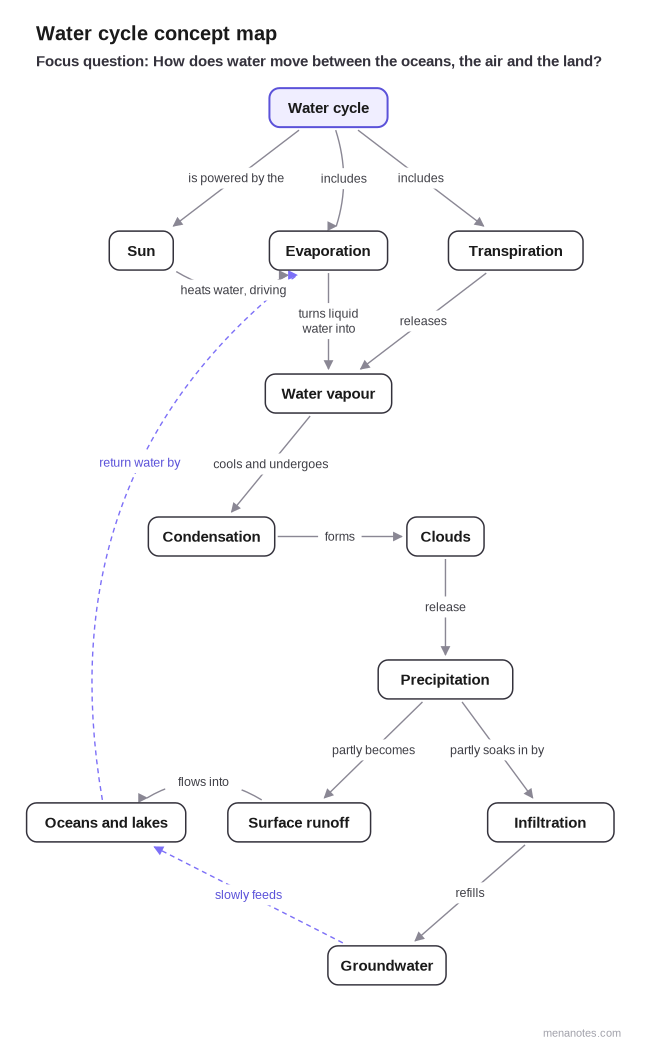
Water cycle concept map
How does water move between the oceans, the air and the land?
-
 Earth science
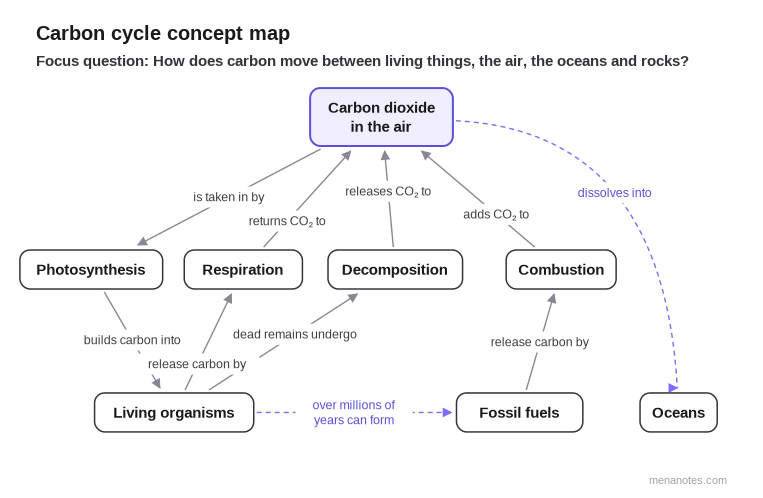
Carbon cycle concept map
How does carbon move between living things, the air, the oceans and rocks?
-
 Biology
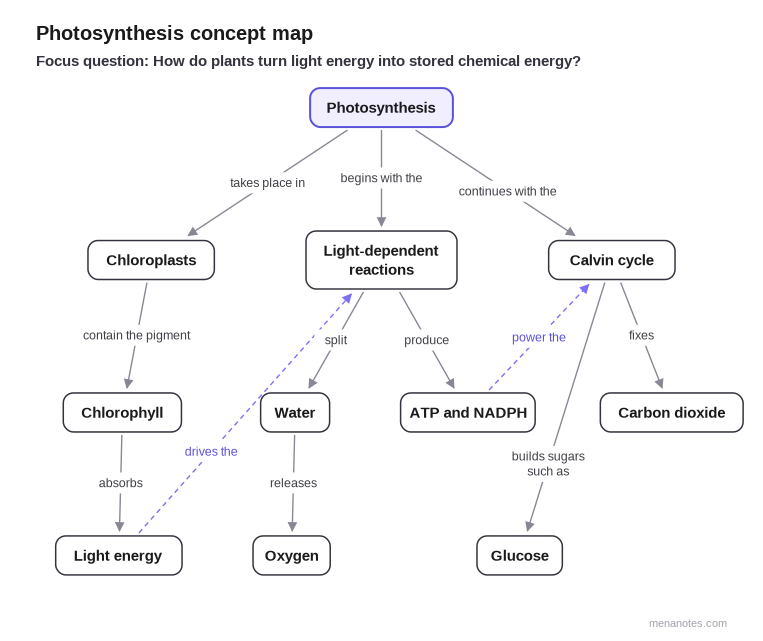
Photosynthesis concept map
How do plants turn light energy into stored chemical energy?