
Carbon cycle concept map
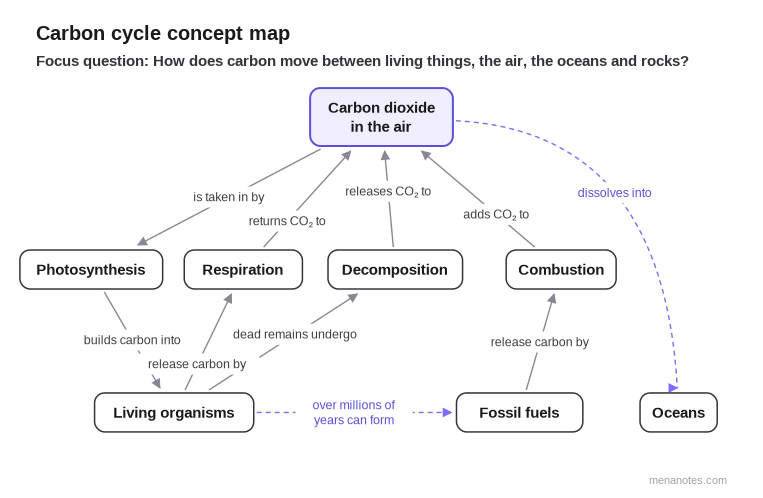
Carbon moves constantly between stores: the atmosphere, living things, the oceans and rocks such as fossil fuels. This map names each store and the process that moves carbon into or out of it.
Read the map as sentences
Every arrow is a proposition. Read aloud, the map says:
- Carbon dioxide in the air is taken in by Photosynthesis
- Photosynthesis builds carbon into Living organisms
- Living organisms release carbon by Respiration
- Respiration returns CO₂ to Carbon dioxide in the air
- Living organisms dead remains undergo Decomposition
- Decomposition releases CO₂ to Carbon dioxide in the air
- Living organisms over millions of years can form Fossil fuels
- Fossil fuels release carbon by Combustion
- Combustion adds CO₂ to Carbon dioxide in the air
- Carbon dioxide in the air dissolves into Oceans
Carbon cycle: what the map shows
Photosynthesis is the main route out of the atmosphere: plants and algae take in carbon dioxide and build it into sugars. Animals eat plants and pass the carbon along food chains.
Respiration by plants, animals and decomposers returns carbon dioxide to the air. Remains that are buried before they decompose can, over millions of years, become coal, oil and natural gas.
Burning fossil fuels releases that stored carbon quickly, which is why atmospheric CO₂ has risen since the Industrial Revolution. The oceans absorb part of it, which also makes seawater more acidic.
Common mistakes
- Plants respire as well as photosynthesise, day and night.
- Fossil fuels are not a fast part of the cycle: they took millions of years to form but release their carbon in moments.
Make it your own
Drawing the map yourself is where the learning happens. Start from the focus question, list the concepts first, then link them with your own words. A blank concept map template gives you the boxes; the concept map guide covers the method.
Make and edit this map in Mena on iPad
Mena is a canvas app for iPad, iPhone and Mac, free to start. Paste this map in, rearrange it, add your own notes and sketches, and turn concepts into flashcards.
Get Mena on the App Store- Copy this map as text.
- In a Mena board, open More tools in the toolbar, choose Diagram from Text and paste. Each concept becomes a shape and each linking phrase a connector label.
- Drag concepts around, rename linking phrases and draw your own cross-links. Connectors stay attached when you move a shape.
- Export the finished board as PNG, SVG or PDF.
More concept map examples
-
 Earth science
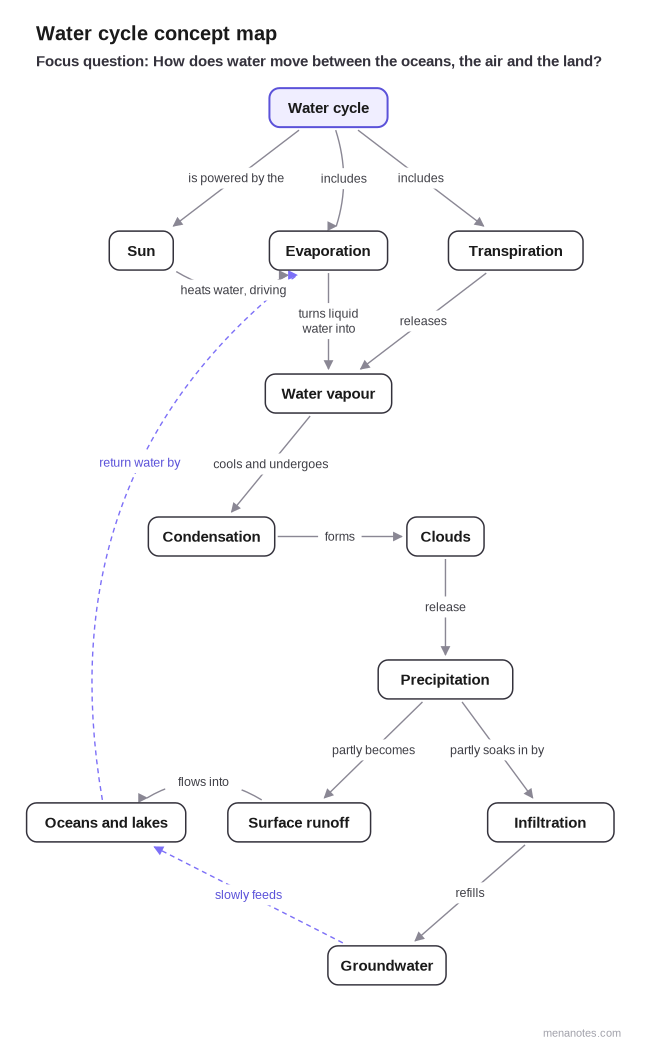
Water cycle concept map
How does water move between the oceans, the air and the land?
-
 Earth science
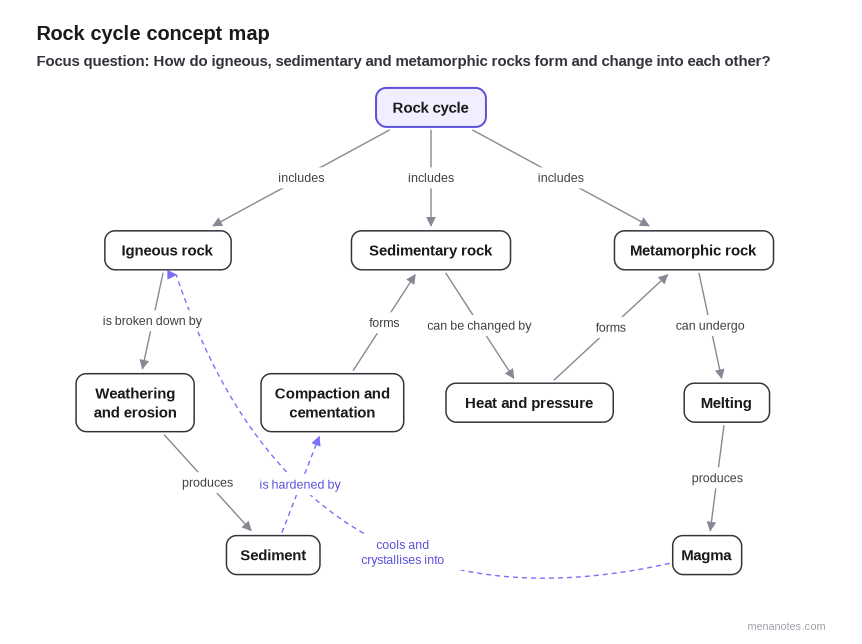
Rock cycle concept map
How do igneous, sedimentary and metamorphic rocks form and change into each other?
-
 Biology
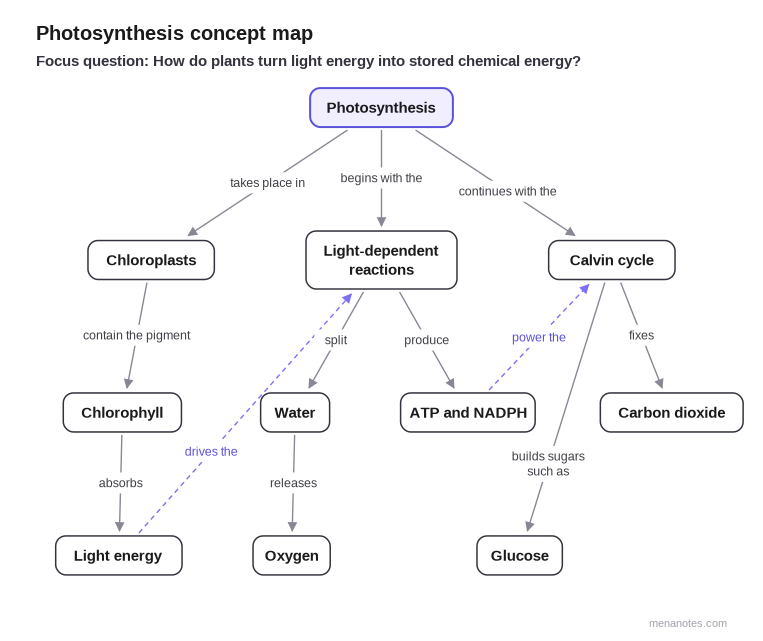
Photosynthesis concept map
How do plants turn light energy into stored chemical energy?